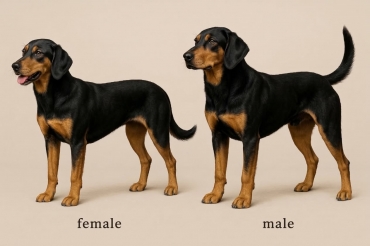
* FCI-CLASSIFICATION: Group 6. Hounds and related breeds. Section 1.2 Medium-sized hounds. With field trials.
BRIEF HISTORICAL SUMMARY: Hunting with hounds was first documented in Lithuania in 1566. The Lithuanian hound was first mentioned in 1541 in a court case involving a forest ranger from Grodno. In the Middle Ages, when the manors were prosperous, breeding a pack of hounds was an honour to every noble. This tradition was not ignored by Lithuanian manors, which were abundant in the Kingdom of Lithuania and Poland. The nobles took the hobby of hunting with hounds from France, having had close relations with this country since the 16th century. Descriptions of Lithuanian hounds can now be found only in Russian hunters' publications. A lot of data can be found in L. Sabanejev's book Hunting Dogs. Greyhounds and Hounds, which was published in the last century (he takes his data from other authors: S. F. Davidovich (1875) and D. A. Vilinsky (1876)). In his books he describes larger and smaller breeds of hound. The larger breed he calls the Lithuanian Ogar; these are big and strong dogs, suitable for hunting large animals on flatlands, but not very suitable for hunting in hilly terrain. Mostly of the dogs mentioned in the books are black hounds with tan spots. In 1957–1958, the cynologist Z. Gostautas began to revive the breed. At that time, Lithuanian hounds were still kept in Zemaitija. Since the hounds were not used as guard dogs, they were only kept by hunters, which helped to prevent mixing. These hounds were descendants of the hounds described by L. Sabanejev, D. Vilinsky and V. Korsak in the last century. The current Lithuanian hound was revived from the aforementioned breeds. In 1966 a temporary standard of Lithuanian hounds was adopted; a breeding dogs’ group was formed, and consistent breeding work also was started. A permanent standard was adopted in 1988.
GENERAL APPEARANCE: Rustic dog. The body is rectangular-shaped. The coat is black with pronounced tan points on the muzzle, chest, underbelly, and the inner side of the legs and on the eyebrows. Clear (prominent) boundaries between brown and black colour. They are generally big and robust dogs with a strong and massive bone structure.
IMPORTANT PROPORTIONS: The body is rectangular-shaped, with the length of the body slightly exceeding the height at the withers. Leg length (from ground to elbow) is slightly more than half of the height at the withers, giving a balanced and athletic outline. The head is well proportioned to the body; in males the head is slightly longer than in females. The forehead is moderately broad, in harmonious proportion to the length of the head.
BEHAVIOUR/TEMPERAMENT: Peaceful, trustworthy, and very strong. Very active, energetic, agile and persistent. Intelligent, with good orientation, cheerful and good-natured. Suitable for hunting and following the blood traces of an injured animal. A variety of barks and a well-developed sense of orientation distinguish them from other hounds.
HEAD: Wedge-shaped, large, but not rough. The muzzle is slightly shorter than the forehead. The length of the forehead is slightly greater than the width of the head.
CRANIAL REGION: Skull: Rectangular shape. The top is slightly convex seen from front, flat-shaped seen from profile. The back of the head is smooth, not protruding. The eyebrow arc is clear but not high. Forehead is wide. The axes of the muzzle and the skull are parallel.
Stop: The transition from forehead to muzzle is sloping, but clearly defined.
FACIAL REGION: Nose: Black and wide.
Muzzle: The back of the nose is smooth. The muzzle is slightly shorter than the forehead. The profile of the muzzle is wide and relatively narrow when viewed from above.
Lips: The upper and lower lips are slightly sagging; the lower lips are loose at the ends. The lip line is oblique, rising slightly towards the ends of the lip.
Jaws/Teeth: White, regular shape, large teeth, close together and intact, with a well-defined scissor bite. All 42 teeth are mandatory. If a dog is over seven years old, it may have a pincer bite.
Cheeks: An indistinct indentation under the eyes, between the cheeks and the nose.
EYES: Dark (black, dark brown or brown), almond shape, medium-sized, obliquely set eyes are preferable. Live and energetic expression. Eyelid incision is slightly oblique (the inner eye corners are below the outer). Eyelids are tight and black.
EARS: Slightly above the eye line. The ears are triangular, with rounded ends, and of medium length. The ears are just over half the length of the head. The front part of the ear is close to the head (the cheeks).
NECK: Robust, muscular, round, with no drooping (meaning that there are no wrinkles). The neck smoothly, gently gives way to the shoulders, it is slightly shorter than the head.
BODY: The dog has a solid body.
Withers: Wide, distinct from the back line. On the withers, the hair is slightly longer than the hair elsewhere.
Back: Straight, broad and muscular.
Loins: Medium-length, broad and muscular. Slightly sloping and round.
Chest: Broad and deep, reaching the elbows and below. The chest is oval. The breastbone (prosternum) is well expressed and developed.
Underline and Belly: Slightly tucked up.
TAIL: The base is thick, thinning further along, preferably in the shape of a sword. The tail is held below the top line. Naturally, the tail is carried above the back. Lowered, the tail reaches the joint of the hock. The tail is black, while on the inner side, at the base it is brown. The tail is covered with dense hair. The hair on the tail sometimes can be a little longer than the hair on the coat.
LIMBS
FOREQUARTERS:
General appearance: Straight. Viewed from the front, parallel. Dry and muscular.
Elbows: Pointing straight back
Metacarpus (Pastern): Short, medium width, moderatly slopping.
Forefeet: Round. Toes well bent, the nails are always black and strong. Footpads are black and well developed.
HINDQUARTERS:
General appearance: Viewed from behind, straight and parallel. Without rudimentary toes.
Thighs: Muscular.
Hock joint: Sturdy.
Hind feet: Paws round, the toes are tight and arched. The pads are black and well developed.
GAIT/MOVEMENT: Movement is strong, unrestrained, free and energetic, with good reach and drive. The limbs move smoothly, straight and parallel to each other.
SKIN: The skin is firm, elastic and without lumps. Muscles are well developed.
COAT:
Hair: The coat is dense and glossy, consisting of strong, coarse and closelying hair. The hair on the back, neck and tail is longer, reaching up to 5 cm. The hair on the legs and ears is short. The undercoat is the same colour as the coat (black).
Colour: Black, dark tan on the muzzle, eyebrows, chest, underbelly, inner leg side and tail (on the inner side near the base). The tan is like brown spots over each eye, and over the cheek, lips, lower jaw and throat; two symmetrical spots on the chest, ankles, slacks, as well as on the inner sides of the legs. Clearly defined markings. The forehead, ears and back, as well as the outside of the legs and the tail are black. The hair is black from root to tip.
SIZE AND WEIGHT
Height at the withers:
Males 58 to 64 cm. Females 53 to 59 cm. Weight: In accordance with size.
FAULT: Any departure from the foregoing points should be considered a fault and the seriousness with which the fault should be regarded should be in exact proportion to its degree and its effect upon the health and welfare of the dog and its ability to perform its traditional work.
Coat is too short on the body. Yellow (straw-coloured) eyes. Very bright coat tan. Larger than the breed standard, – up to 2 cm (height at the withers). Black spots on the front legs brown (tan) coat. Highly raised ears, too short or too long, the front part is not smooth. Clearly visible light undercoat on the neck or near the ears, obscuring the main coat colour. Coat is too long at the tail – feather tail. Long hair on the outside of the thighs, the so-called pants. Tan spots on the black part of the coat. Tan on the head, or at the base of the ear. Sickle-shaped tail
SEVERE FAULTS:
Smaller than the standard for the breed (height at the withers).
Heavy, rough head. Muzzle too short.
Raised or sloping loins.
Poorly developed front legs, heavily rotated, pivoted in or out.
Irregular body shape: square.
Clearly raised nose bridge.
Absence of more than two P1 premolars.
Undeveloped breastbone (this is a fault if the dog is three years or older).
Unclear boundary between the tan and the main colour – when tan colour hair mixes with black hairs and are scattered widely. The boundary is not visible.
Partially depigmented (grey) stripe at the centre of the nose (between the nostrils).
Poorly developed, narrow chest, not reaching the elbows.
Poorly developed, deflected backline.
When black hair is black only at the tips and the roots are grey or brown.
Clearly visible undercoat throughout the body, beating the main coat colour.
DISQUALIFYING FAULTS:
Aggressive or overly shy dogs
Any dog clearly showing physical or behavioural abnormalities shall be disqualified
Completely depigmented stripe in the middle of the nose
Absence of any teeth, P1 and M3 are not taken in consideration.
Eyes of all other colours not listed in the standard
Wrong type of bite: over-bite or under-bite
White spots: a spot or a stripe on the chest or neck, spots on toes or paws or on other areas of the body
Not typical tail shape: very curled
N.B.: Male animals should have two apparently normal testicles fully descended into the scrotum. Only functionally and clinically healthy dogs, with breed typical conformation, should be used for breeding.
...
* Waiting for breed recognition.
TRANSLATION: Mantas Milinavičius and Irmantas Brazaitis, official language - lithuanian.